
Redson Dev brief · PRIMARY SOURCE
Science One Framework: A verifiable autonomous research framework via Chain-of-Evidence
Google Research · July 30, 2026
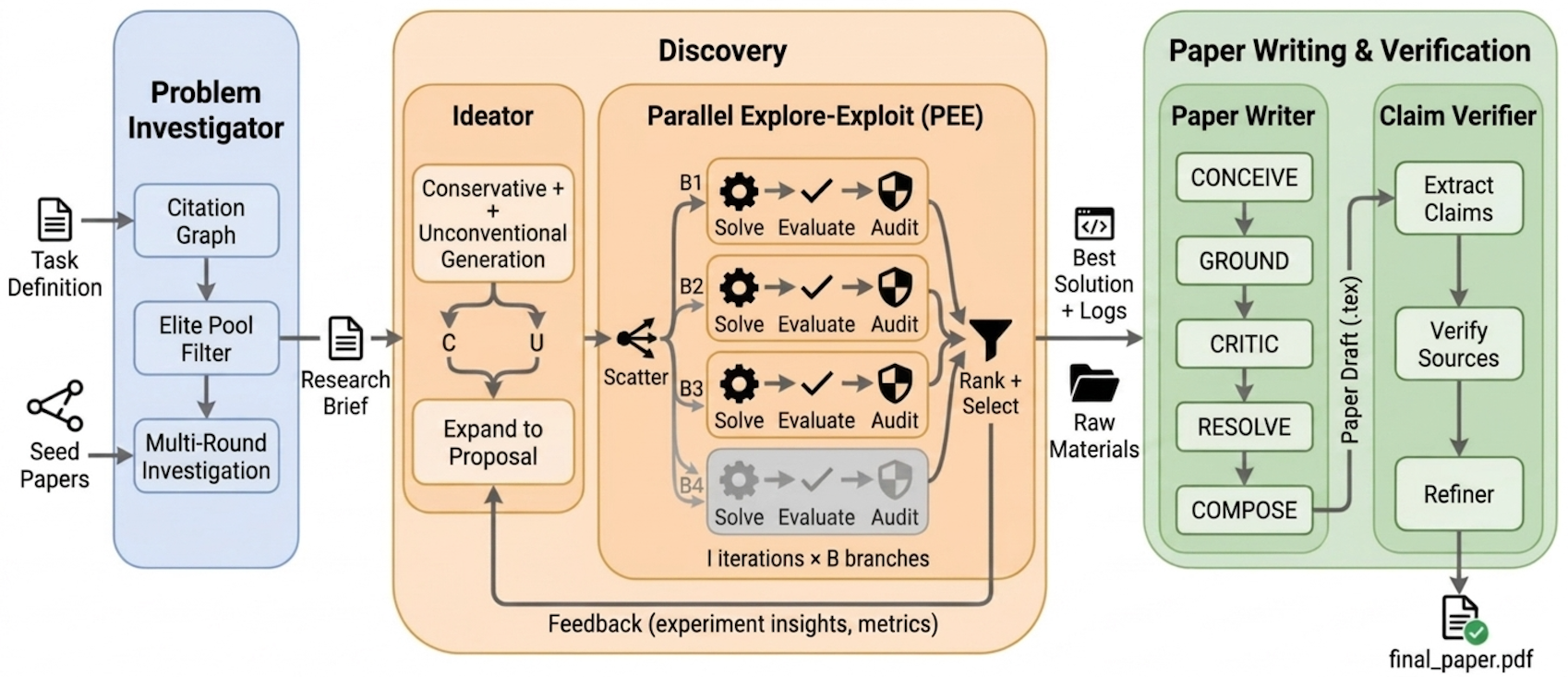
Your ability to rapidly validate and extend scientific discoveries through autonomous research just became significantly more accessible. Google Research’s "Science One Framework" introduces a verifiable autonomous research framework built upon a "Chain-of-Evidence" methodology. This system essentially creates a transparent, auditable trail for each step of an AI-driven scientific investigation, allowing researchers to trust and build upon automated findings with unprecedented confidence. This development fundamentally shifts how independent researchers, small businesses, and internal development teams can approach complex problem-solving. Consider a solo software developer in Austin, Texas, working on a novel algorithm for optimizing urban delivery routes. Instead of painstakingly validating every potential variable through manual experimentation or relying on opaque AI predictions, they could leverage a framework like Science One to autonomously explore variations, with each computational step and its supporting evidence recorded and verifiable. This allows them to iterate faster, understand the underlying reasons for observed performance, and confidently integrate the optimized solution into their logistics platform. Similarly, a small manufacturing startup in Detroit aiming to discover new materials with specific properties could use such a system to test countless combinations virtually, receiving not just a result, but a complete, auditable record of the journey to that result, accelerating their R&D cycle and reducing material waste. For an internal IT team at a mid-sized financial firm in New York City, tasked with identifying subtle vulnerabilities in legacy systems, this framework could offer a way to automate deep systems analysis. Rather than human analysts sifting through mountains of logs and code, a Science One-like system could autonomously probe the system, presenting not just potential vulnerabilities, but the precise chain of evidence — the specific log entries, code paths, and configurations — that led to its conclusion. This enhances security, reduces human error, and provides clear, actionable intelligence for remediation. To begin exploring this concept, spend precisely one hour this week outlining a complex problem you face that currently requires extensive manual validation or trial-and-error experimentation. Then, map out how an "auditable trail" or "chain of evidence" for each decision point in an autonomous problem-solving agent could fundamentally change your approach to solving it.
Source / further reading
Learn more at Google Research →